
In the Beginning… God Created (Genesis 1:1)

Here’s my sermon from this past Sunday, March 1st. It’s my third sermon in our new Genesis series. I take on the doctrine of creation. You can check out the audio right here.
Back in the fall of 2021, my wife Amy and I joined our friends Bobby and Laura for a concert at an amphitheater over near St. Louis. Now I don’t think Amy had even heard of the artist. But I, for one, happen to think Phoebe Bridgers is pretty brilliant - even if our worldviews couldn’t be further apart. Now, despite the fact that we looked a little out of place - not being teenage girls dressed in black, you know - it was a great evening, a moving show. And on the setlist that night was her song “Chinese Satellite” - one of my favorites. Listen to the lyrics:
“Took a tour to see the stars
But they weren't out tonight
So I wished hard on a Chinese satellite
I want to believe
Instead I look at the sky and I feel nothing
You know I hate to be alone
I want to be wrong” (Phoebe Bridgers)
Gazing up into the night sky, she longs for there to be someone out there. Someone who would fill her heart with wonder. One who could infuse her with purpose. One who might fill that void inside her. This morning, as we go back, and we look at that first sentence of our Bible, we’ll read about that Someone. The one who hung those stars. And holds them all in space. Maybe you’re like Phoebe. You just can’t get yourself to believe. But you want it all to be true. I want you to see - to hear - a portrait of that God here in this passage. Genesis 1, verse 1. “In the beginning, God created the heavens and the earth.”
Last week, Aaron looked at how the Bible and science might actually be friends. This week, we’re going to consider the doctrine of creation. What do we learn about what God does, along with who He is, here in this verse? And how should that impact the way you and I live?
In the Beginning
“In the beginning, God created the heavens and the earth.” Now maybe you hadn’t heard, but Aaron and Caitlin Ferguson are at the hospital now. And they’re about to have their second baby. They should meet their son today. But that precious little child had his start almost nine months ago. And he’s been developing in her womb ever since.
Verse 1 here reads like an introductory verse. Yes, it says that our creation has a beginning. More on that in a bit. But this describes that beginning more as a period of time. Somewhat like that gestational period - that spans conception and birth. This verse is a summary of what God does. Of all we see happen here in chapters 1 and 2. Moses takes us back to when this creation got its start, when it was birthed out, as it were, by God. To those first days, when God made everything.
Contrary to what might be taught today, everything we see - what we call God’s creation - it’s not eternal. No. We can debate how old it all is. But it had a beginning. And we see that right here. The Lord is eternal. Him and Him alone. He created time. He stands outside of time. As it reads in Psalm number 90, a prayer attributed also to Moses:
Psalms 90:1 Lord, you have been our dwelling place
in all generations.
Psalms 90:2 Before the mountains were brought forth,
or ever you had formed the earth and the world,
from everlasting to everlasting you are God.
Psalms 90:3 You return man to dust
and say, “Return, O children of man!”
Psalms 90:4 For a thousand years in your sight
are but as yesterday when it is past,
or as a watch in the night.
He has no beginning and no end. He is infinite - with respect to space - but also time. The Lord alone is eternal. Think about what that means. You’re in London in 1941. And the Blitz is happening. The Nazis are bombing your city. It feels like the world is blowing apart. You’ve already lost loved ones. And you think it’s a matter of days until that red and black flag is flying there, too. Now that moment is just one little dot on this line of time that extends infinitely in both directions. Yes, there’s a dot way back, when the Lord got everything started. And there’s one in the future, when He’ll make everything right. But there’s that one frightful evening, where your ancestor hides in that basement. And there is where we find ourselves also, stressing about our world today. This day. This moment. Is just a dot on that line. And God is with us. And He is above and beyond it all. His eternality. His infinitude. It gives us peace. And it also leads to hope. Because this introduction here also implies a conclusion. When He’ll come again and restore this creation.
But that’s not all we need to remember. What was God doing throughout eternity past? You know, before the creation? Well, listen to Christ’s words in John 17. Verse 24: “Father, I desire that they also, whom you have given me, may be with me where I am, to see my glory that you have given me because you loved me before the foundation of the world.” There, before the foundation of the world, what do we see? Love. Here between Father and Son. But also with the Holy Spirit. Triune love. More on the glory part after bit. But this means God - ultimate reality - is personal. As Jesus prays further, in John 17:26, “I made known to them your name, and I will continue to make it known, that the love with which you have loved me may be in them, and I in them.” Maybe the One who made all this, as Jesus clearly says, wants to know us, too. And to pull us up into that love. That’s what the Lord prays for. We don’t have to be alone. Let’s keep moving.
God
“In the beginning, God created the heavens and the earth.” Here’s how the Bible begins. With God. As D.A. Carson puts it,
“The Bible does not begin with a long set of arguments to prove the existence of God. It does not begin with a bottom-up approach, nor does it begin with some kind of adjacent analogy or the like. It just begins, 'In the beginning God’” (Gen. 1:1). (D.A. Carson)
God simply is. He is self-existent. And He’s also self-sufficient. God didn’t make us because He was lonely or bored. And certainly not out of some kind of need. As Thomas Aquinas once explained it, everything that exists does in one of two ways: “either as (a) necessary and infinite and eternal or (b) contingent and finite and perishable.” Guess which one God is? He’s not contingent upon anyone or anything - to come into existence or to sustain that existence.
This reminds us that His creation wasn’t necessary. Right? As Chris Watkin puts it, it’s “gratuitous.” Creating all this didn’t fill up some need God had inside. And He also doesn’t need us - not even a bit. But I want you to hear that that is really good news. Let me try to explain.
As I lead here in Karis, if I tie my identity too closely to you - if my existence and my sustenance truly rests in you - I can’t really love you very well. Because I’m probably really just using you. Right? To feed my ego. To give me significance. My identity is all wrapped up in you.
In contrast, think about our Lord. Because He just is - and has no need outside of Himself - He freely made us. He freely rescues us. Without a need for anything in return. He just wants to. He does it out of love. A God strong enough not to need you and your help is also one strong enough to help you in your time of need.
Listen to Psalm 121:
Psalms 121:1 I lift up my eyes to the hills.
From where does my help come?
Psalms 121:2 My help comes from the LORD,
who made heaven and earth.
But there’s something more basic that Moses is telling us here. There’s only one God. And He made all this. This expresses what God’s people have always believed. Monotheism. There is only one God. But as Christians, we also believe that one God exists eternally as three persons. There we see that personality, that love. And we also see how the persons complement one another. Each playing their part in both creation and redemption. And we love imaging that here. As we all use our gifts. It’s not about me - or anyone here.
But this also speaks against other, false gods. It condemns idolatry. Those rival Gods of the ancient near east - Marduk. Other gods didn’t make all that we see here. As Psalm 96:5 expresses, “For all the gods of the peoples are worthless idols, but the LORD made the heavens.” And this, of course, includes our most prominent idol today.
Last week, Aaron quoted Alvin Plantinga. I’ll put his words back up on the screen.
“There is superficial conflict and deep concord between science and theistic religion, but there is superficial concord and deep conflict between science and naturalism. (Alvin Plantinga)
See, the problem isn’t between faith and science. It’s between faith and naturalism. That says nature is all that there is. That says science is everything. Because, according to God’s word. He is who is behind His world. And that leads to our next point.
Created
“In the beginning, God created the heavens and the earth.” No, the creation didn’t make itself. It’s not self-caused. No. The Lord did it. And He did it without using any preexistent materials.
If I build a bookcase or I cook up a stew, I use wood and glue or meat and vegetables. I’ve got make a run to Home Depot or Hy-Vee. God created ex nihilo - out of nothing. That’s what that Latin term means. Hear how Hebrews 11:3 puts it: “By faith we understand that the universe was created by the word of God, so that what is seen was not made out of things that are visible.” Or in Revelation chapter 4:
Revelation 4:11 “Worthy are you, our Lord and God,
to receive glory and honor and power,
for you created all things,
and by your will they existed and were created.”
If I build that bookshelf, I’m not gonna stand there and think real hard - like Eleven in Stranger Things - in reverse - and will it into existence. With no supplies anywhere in sight. And I’m not going to ask you over for dinner and then just command, through my words, “Let there be goulash and sourdough bread,” and it appears.
But that’s the second thing we learn here, as we read on in this passage. The Lord creates everything by His word. Just start with chapter one, verse 3. “And God said, ‘Let there be light,” and there was light.” And it goes on from there. God creates out of nothing. And by His word. Psalm 148:5: “Let them praise the name of the LORD! For he commanded and they were created.” Or Psalm 33:6: “By the word of the LORD the heavens were made, and by the breath of His mouth all their host.” Out of nothing. By His word. That’s how “God created.”
Now this, of course, reminds us that our Lord is powerful. He’s almighty. Omnipotent. To do all this - just by speaking the words - that’s power! But we also are reminded again that He’s a relational God. A talking God. As Aaron said last week, He’s communicated through the word, through Scripture. And He’s communicated through His world, His creation. He spoke each into existence. And through each He still speaks. We see Him, we hear God. Maybe the Lord wants to know us. To have a relationship with us.
But why else could this matter? Well, if God can create all this - if He’s that powerful - then He’s also strong enough to redeem. That’s the exact point Paul’s making in Romans chapter 4. The Lord tells Abraham, “You don’t even have a kid. Your wife is older than dirt. But I’m going to make you a ‘father of many nations.’” Now how’s that? Paul explains: Abraham was standing “in the presence of the God in whom he believed, who gives life to the dead and calls into existence the things that do not.”
Look also over in 2 Corinthians chapter 4. If we’re rebels against God, how will anyone be saved? Why is it not futile to go out and preach Christ? He writes, in verse 6: “For God, who said, ‘Let light shine out of darkness,’ has shone in our hearts to give the light of the knowledge of the glory of God in the face of Jesus Christ.” So for that coworker who won’t listen, or that prodigal kid who’s life’s a wreck, maybe we should pray and hope. And not give up on others - or even ourselves. And trust that He can do big things. In our scariest, biggest problems, in our deepest, darkest valleys. This is our God, Karis! As Andy Mineo translated it, Lord, “You make something out of nothing!” He can - and He cares.
The Heavens and the Earth
“In the beginning, God created the heavens and the earth.” Now those words there don’t just describe two things. What’s above. What’s below. He made both. No, that’s a way to describe the full range of everything God made. It’s a way to say He made everything. All of His creation. And that of course includes us.
The Lord, again, using no preexisting materials - made everything we can see. And He made it all in wisdom. Hear how it’s put in Proverbs chapter 3.
Proverbs 3:19 The LORD by wisdom founded the earth;
by understanding he established the heavens;
Proverbs 3:20 by his knowledge the deeps broke open,
and the clouds drop down the dew.
Or in Psalm 104:24. “O LORD, how manifold are your works! In wisdom you made them all; the earth is full of your creatures.” If we have eyes to see, we look and see His design. A world that works. Perfectly tuned for life. We see His wisdom.
But we also see His kindness. Back in Genesis 1, what else do we read? After God creates by His word? He calls it good, right? See it in chapter 1, verse 4: “And God saw that the light was good.” And that gets repeated here throughout until humans are finally made. And then the Lord says, down in verse 31: “And God saw everything that he had made, and behold it was very good.”
Now this God’s evaluation. One we should embrace as well. Good in that it’s perfect. Probably what it mainly means. But It’s also good that it brings joy. Right? As we ponder all that He’s made. And hear Him speak through His creation. The Lord we saw made time. He’s also created place. That showcases His wisdom and kindness.
What we see is functional. Right? But it’s also beautiful. And so much is delightful. Ordered. But creative. And abundant. We live in an enchanted world.
And we don’t have to fear His creation. This material world. What the church has often taught us to do. We don’t believe in gnosticism. Where Spirit is good. And matter is evil. No. It’s given as a gift. As Michael Bird puts it, “Creation should be enjoyed not worshipped, stewarded not exploited, embraced and not escaped.”
His creation is not eternal. It also wasn’t necessary. It’s not self-caused. But it also lacks in nothing. My friend Jim reminded me recently of a way He’s applied this chapter. God looked at all He had made. And He stopped. He, yes, said it was good. But also, that it was enough. And we need to be satisfied in what He’s given us, as well. But also, as we go about working and creating, we need to recognize our limits. And know when to walk away. To say, “That’s good.” To say, “That’s enough.” And yes, then go and rest. “In the beginning, God created the heavens and the earth.” I want to finish by thinking even more deeply about what this all means - about who God is, along with who we are, as well as how it should impact how we live.
Two Kinds of Existence
First, I want you to think of two kinds of existence. Foundational to the Christian worldview is what we call the Creator-creature distinction. The Creator. The created. Only two kinds of existence. God and what He’s made. God and not-god. Not God and the devil. No, even Satan was created. As I said earlier, from Aquinas, everything is “either… (a) necessary and infinite and eternal or (b) contingent and finite and perishable.”
Two Truths about God
Second, I want you to know two truths about God. It’s so important that we understand that God is both transcendent and immanent. I’ll take each of those in turn.
The Lord is transcendent. As Isaiah 55 puts it so well: “As the heavens are higher than the earth, so are [His] ways higher than [our] ways and [His] thoughts than [our] thoughts.” He is transcendent. In terms of His majesty. But also His holiness. Far exalted above His creation. High and lifted up.
But He is also immanent. Maybe you’ve seen those memes, how punctuation saves lives. You know what I mean? It’s not “let’s eat Grandma.” That turns you into cannibals. It’s “let’s eat, Grandma.” You gotta have that comma. It makes a really big difference. Grandma either shares your meal or becomes your meal.
But we could say spelling, really vocabulary, is even more important. There are three different ways we spell the word immanent. Three homophones. The first is like this: imminent. That is something that’s soon to happen. It’s coming. Like Christ’s return.
The second is like this: eminent. That’s someone who’s respected or known in their field. Paul Wegner is an eminent Old Testament scholar. But the third is spelled like this: immanent. To say God is immanent means that He’s not just high and lifted up, separated from us, but He also draws near. He’s involved in His creation. He comes down. Immanent is not so much an opposite of transcendent as it is its complement. The One true God who made all we can see - He is both.
So why does vocabulary save spiritual lives? Because if you believe the end of the world is imminent - coming soon - but you don’t believe the God of the world is immanent still - involved in our life - you’re, as the kids, say, totally cooked. You’re likely to implode. So know your theological vocab words. It’s a matter of life or death. God is transcendent. But He’s also immanent. Hold on to those terms. He’s close - and He’s kind enough - to take interest in our lives. But He’s also big and powerful enough to actually do something about it.
At risk of drowning you with more vocab words, have you ever heard of deism? It’s often described this way. The Lord made the heavens and earth. He wound it up like an old manual wristwatch. And left it to just do its thing. Stooped down from heaven. Flew back up there again. And now stays uninvolved.
Here’s another. It’s pantheism. Creation is God. Or some how contains Him inside. You’ve heard this, I’m sure, before. Love your mother earth. The first, deism, is all transcendence. God is far away and distant. The second, pantheism, is all about immanence. The heavens and earth are Him.
But here’s a way that might hit even closer to home. As D.A. Carson explained it so well, the Lord isn’t some distant king who couldn’t care less about us. Where He’s only transcendent. But He’s also not this soft grandfather who just gives us what we want. Where forgiveness is His job. There He’s only immanent. But He’s also not an equal to us, a business partner, where we strike up deals. Where we scratch His back, and He scratches ours. No, the God of the Bible is powerful. He made all things out of nothing, by His word. But that transcendent One stoops and creates. And then, after the fall, He descends and redeems. But it’s seen most clearly, as God becomes man, as the Creator enters His creation. He becomes immanent in Jesus Christ the Lord. The exalted God wants to be friends. Really, to make us His family.
Two Questions about Creation
Third, I want to answer two questions about creation. To this idea that “in the beginning God created the heavens and the earth.” You might ask, what now? Or even, what for?
Let’s first take what now. The Lord sustains and governs all He has made. This is what’s known as the doctrine of providence. The Lord is still active, holding this world together. Without His work, it would all break apart. There is His sustaining work. Hebrews 1:3 explains it this way: “He uploads the universe by the word of His power.” His word created it all. His word sustains it all.
Listen to Colossians 1:16-17, what it says about Christ:
Colossians 1:16 For by him all things were created, in heaven and on earth, visible and invisible, whether thrones or dominions or rulers or authorities—all things were created through him and for him.
Colossians 1:17 And he is before all things, and in him all things hold together.
That’s God’s sustenance. But there’s also His governance. He rules over His creation so that everything happens, just as He wants. Ephesians 1:11 puts it so clearly, saying that everything in the universe - including salvation - works “according to the purpose of him who works all things according to the counsel of His will.” Even in this now-fallen world, He holds it all together. He has everything under control. We don’t have be filled with anxiety. We don’t have to manage everything. He made all this. He’s got it under control.
Let’s second take what for. Let’s go back to John 17, this time in verse 5. Jesus prays to His Father: “And now, Father, glorify me in your own presence with the glory that I had with you before the world existed.” Long before creation, in this Triune relationship of love, there has been glory shared, between Father, Son, and Spirit. And that God in three persons desired to let that glory overflow to us. To let us see it. To let us reflect it.
Psalm 19 is one of my faves. God reveals Himself in the word. That’s the second part of the Psalm. But the first six verses say He reveals Himself in the world.
Psalms 19:1 The heavens declare the glory of God,
and the sky above proclaims his handiwork.
Psalms 19:2 Day to day pours out speech,
and night to night reveals knowledge.
Psalms 19:3 There is no speech, nor are there words,
whose voice is not heard.
Psalms 19:4 Their voice goes out through all the earth,
and their words to the end of the world.
In them he has set a tent for the sun,
Psalms 19:5 which comes out like a bridegroom leaving his chamber,
and, like a strong man, runs its course with joy.
Psalms 19:6 Its rising is from the end of the heavens,
and its circuit to the end of them,
and there is nothing hidden from its heat.
The world’s speaking - it’s preaching - in some way without words. And it’s shouting out with joy. And what’s it saying? That God is glorious. That’s why God the world. And I might add - why He redeemed it, too. So that we would see His glory and praise Him. Whereas earlier, I said He didn’t need anything from us, here there is something that He desires for us. For us to see, to rejoice in His glory. He still doesn’t need this. As God, it’s what He deserves. But it’s for our good. It’s for our joy. He won’t let us run after idols.
Aaron’s always talking about teaching his sixth grade Bible class. I have a friend who used to teach at that same school. And he just wrote a book about the glory of God. And he writes about teaching his class about this truth. He sees a student’s eyes light up. He calls on her, and she says, “So, Mr. Berry, what you’re saying is that God is the bomb. He knows He’s the bomb. And He created the world to share His bomb-diggity. Is that right? Donnie summarizes, “Brilliantly right. Out of the mouths of infants and eighth graders.”
Here’s how he explains the “what for” of creation:
“God, out of His infinite fullness, created the world to fill it with his glory. And He created humans to see His glory and delight in it, to share in His glory, and to display it. All this so that we and all creation might participate in God’s eternal joy.” (Donnie Berry)
Two Responses to Creation
On that note, I want to close with two important responses to creation. First, as creatures, we’re meant for delight. In Him, who He is, along with all He’s made. His creation is meant to point us back to Him - every mountain, every otter, every snowflake, every shooting star. Delight. So take a hike. Grab that fishing pole. Go looking for those northern lights. Learn the names of some trees. See His glory and delight in it. And let it move you to sing praise to Him.
Second, as creatures, we’re meant to depend. For every breath. Every meal. From the bassinet to our death bed. We’re not enough. We can’t exist without Him. We can’t thrive without Him. And most of all, we need every word that comes from the mouth of God. We need His word most of all. He is our life. Let’s humble ourselves. Let’s learn to pray. Let’s read our Bibles. And remember we’re just creatures. And how desperately we need God.
Living in an Enchanted World
Gavin Ortlund, in the book The Gospel after Christendom, says that there are three things that plague us here in America today: disenchantment, purposelessness, and loneliness.
Imagine with me: you’re about to board a train, you’re standing at the station. And the ground starts shaking under your feet. Your foundation - it’s moving. And you’re scared. That mentality. That you’re enough. You have all you need. That there’s no God at all - or that He looks and thinks like you. That the universe just happened. That’s never going to work. It’ll crash down one day. Disenchantment, purposelessness, and loneliness.
But hop on that train with me. Look out the windows as we ride. And see the snow-capped mountains. Look at that mountain river below. Then see the elk on the hilltop. An eagle soaring through the skies. And try on this view of the world. Where you’re dependent. On a powerful God who’s also good. And where there is delight. In all that He gives. In the manifold ways that He loves. In that world, there is enchantment. There is purpose. There is community - with God and His people.
Here is the good news: despite the fall, even with our sin, after heaven and earth were split apart at the seams, He chooses to still draw near. The Son who was there at creation chose to enter that creation. And there to redeem all God had made. He was put to death within that creation - there in time and space. He who holds the world together was broken apart Himself that heaven and earth would be brought back together again. But He rose again. He triumphed over death. And one day, He’ll return and raise us up, along with this broken world. That’s what’s coming, friends.
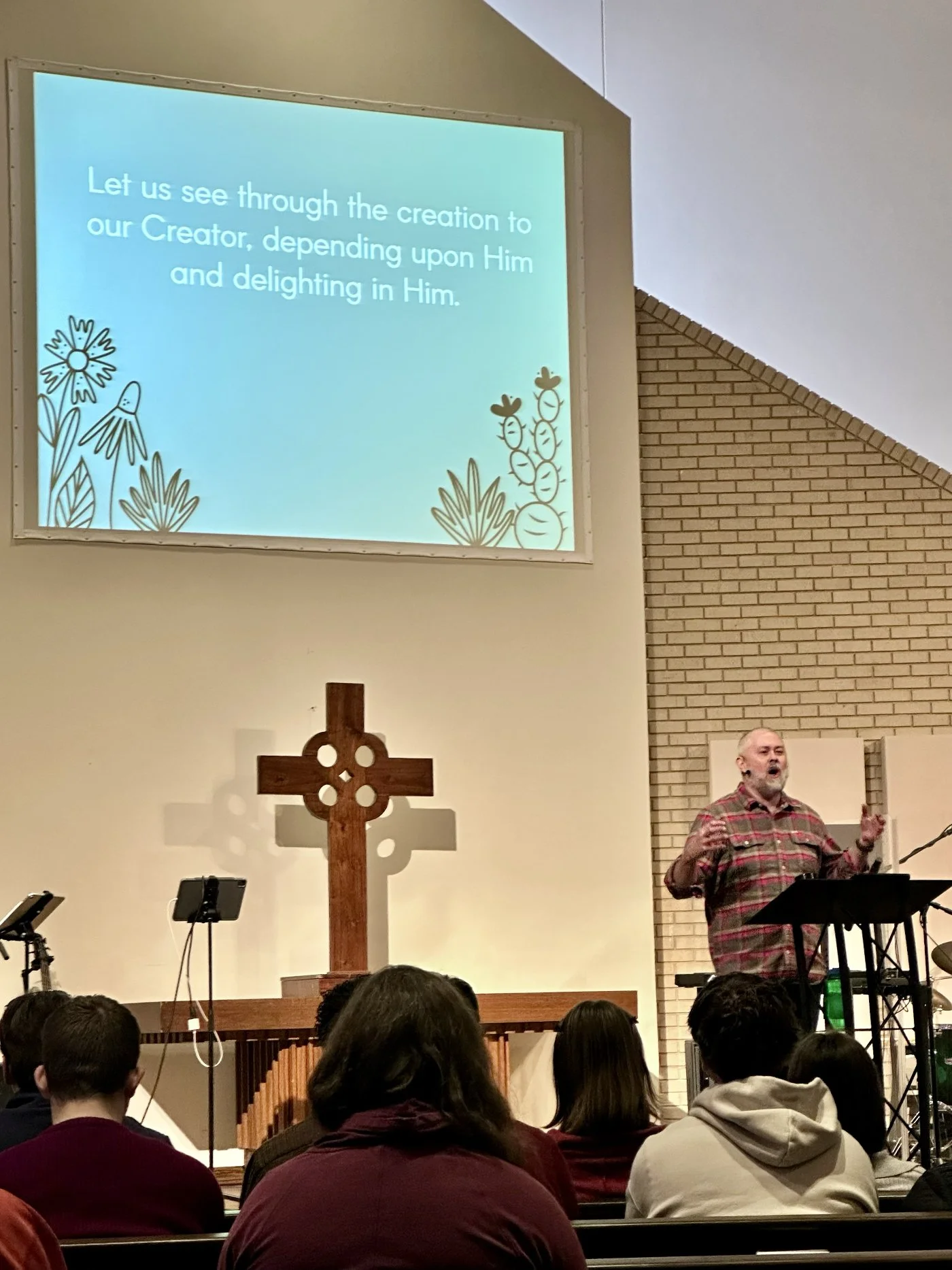
Karis, our God, in the beginning, created everything. Let us see through the creation to our Creator, depending upon Him and delighting in Him. See - and celebrate - the Wellspring. Our Lord God, our Creator overflowed - all His greatness and goodness - it burst forth and rained down in His creation, to His creatures. Let’s drink deeply of His grace. From our fount of every blessing. We desperately need Him. Only He will satisfies us. God wants us to feel that. Let’s pray.