
The Hope of, and Help In, Justice (Genesis 6:9-22)
Here’s my sermon from Sunday, August 23rd, the first looking at Noah and the ark. You can listen to the audio by clicking here. You an also check out our podcast here.
Now I don’t mean to offend. But if you type Noah’s Ark into Amazon, you know what you’ll get. Multiple play sets designed for young kids. Maybe it’s served as your baby room theme. And I get the draw. Animals are cute. Boats are cool. The water. The rainbow. I’m certainly not judging. But I do want to say: the scene we’ve painted leaves out something really important. God is bringing judgment upon the earth!
As Jonny’s prancing that giraffe, up into that ark, you better have some death metal playing. Loud distorted guitars. Angry, screaming dudes. The color on those walls needs to include a whole lot of black. This is a dark, dark scene. As God rains wrath down on His world. But I want you to hear that song fade into a tune that’s more hopeful. And see beams of light peering from behind those clouds. A rainbow that’s about to break across those skies. That’s because of what this flood brings. Justice Something we all desire. That’ll one day come in the future. “We won’t be satisfied,” MLK expressed in that dream, “until justice roll down like waters and righteousness like a mighty stream,” quoting Amos 5:24. We have this hope of justice. And that’s where this story here points. But there’s a problem. One that we’ll see soon.
In verse 9, we see this line that repeats throughout Genesis. Really only one word, in the original Hebrew language. “These are the generations.” And here, it’s said, “of Noah.” And it signifies a break in the narrative. The start of a new chapter. The third in the book. We see the story of him and his offspring, that focuses mainly, of course, on this great flood. And today, here in the rest of chapter 6, on him building this great boat. Justice will roll down, friends. But the wise trip on grace.
Humans Spread Corruption
Look just how far God’s creation has fallen. Last week, Aaron looked at those crazy Nephilim - and just how sinful things had gotten on earth. And it seems like, for the Lord, it’s the final straw. Verses 11 and 12:
Genesis 6:11 Now the earth was corrupt in God’s sight, and the earth was filled with violence.
12 And God saw the earth, and behold, it was corrupt, for all flesh had corrupted their way on the earth.
Three different times, that word “corrupt” is used. What God had made and called good had been ruined. It had been spoiled. And this, by those God had made. Those called to rule on God’s behalf, bearing His image, had abused that authority, turning to “violence,” against one another, and all God’s creatures. The opposite of justice.
Look back at how it’s put in verses 5 through 7:
Genesis 6:5 The LORD saw that the wickedness of man was great in the earth, and that every intention of the thoughts of his heart was only evil continually. 6 And the LORD regretted that he had made man on the earth, and it grieved him to his heart. 7 So the LORD said, “I will blot out man whom I have created from the face of the land, man and animals and creeping things and birds of the heavens, for I am sorry that I have made them.”
God sees. All that evil. God feels. Grief fills His heart. God speaks. And resolves to bring justice. And then we see He acts - in this flood. Hear me. Apartments filled with civilians bombed in Ukraine. Kids dying of preventable illnesses all over Africa. So much evil and violence. Fraud and corruption - everywhere we turn. And still today. This week, people were once again trying to impersonate me - a nobody in the big scheme of things. Messaging our deacons - even my wife - trying to get them to buy gift cards - even telling one leader the cards were for women battling cancer. The irony! All this - even after the flood.
This world has become even more corrupt. Technology hasn’t helped to reign it in. It’s provided new opportunities for evil.
But hear me, church. Yes. Every day today seems dumber and meaner than the one before. But God sees. God feels. He speaks. And one day He will again act. And that should give us confidence and hope. It’s possible Paul has this passage in view, when he pens Romans 8:21. He speaks of the day when “the creation itself will be set free from its bondage to corruption and obtain the freedom of the glory of the children of God.” Humans spread corruption. But violence won’t have the last word.
World Meets Justice
The Lord resolves here to bring justice upon the world. Look at verses 13 and 17.
Genesis 6:13 And God said to Noah, “I have determined to make an end of all flesh, for the earth is filled with violence through them. Behold, I will destroy them with the earth.
Genesis 6:17 For behold, I will bring a flood of waters upon the earth to destroy all flesh in which is the breath of life under heaven. Everything that is on the earth shall die.
I said that world for “corrupt” was used three times just above. But here it’s used again. It’s there, in that word for “destroy.” Humans have destroyed - they have corrupted - the glory of His creation. So the Lord will “destroy” - He will corrupt - the whole thing. It’s like He’s given His fallen creation exactly what they wanted. It reminds me of Paul’s language from Romans chapter 1. He speaks of the Lord giving humans over to their sinful desires. Of that being the judgment. Getting what they want. And that’s what the Lord’s gonna do here, in bringing this flood. It seems all flesh has been involved. And all creation will be impacted. And the Lord is not pleased. World meets justice. We’re going to see it right here.
Now there are a couple of mistakes we can make as we picture our God. We can think of the Lord as a squishy grandfather. Who turns a blind eye, when you do something naughty. But what kind of God is that? Who looks at sex-trafficking, and doesn’t do a thing? The filthy rich, taking advantage of the poor - and just shrugs?
No! We believe in a God who is just. Who looks and cares - and will act. That’s what He does here - in bringing this flood. But it points to the judgment day to come. When evil and violence - all the corruption - will cease.
Now eternal punishment can be a struggle for us all. We tend to minimize His glory. And maximize our goodness. And that makes the punishment in no way fit the crime. But I think the problem more comes down to two main issues. Croatian theologian Miroslav Volf once put it like this:
“‘My thesis... will be unpopular with many Christians, especially theologians in the West…. I suggest imagining that you are delivering a lecture in a war zone.... Among your listeners are people whose cities and villages have been first plundered, then burned and leveled to the ground, whose daughters and sisters have been raped, whose fathers and brothers have had their throats slit...
The thesis: we should not retaliate since God is perfect non-coercive love. Soon you would discover that it takes the quiet of a suburban home for the birth of the thesis that human nonviolence corresponds to God’s refusal to judge. In a scorched land, soaked in the blood of the innocent, it will invariably die.” (Miroslav Volf)
What’s he saying? That a first problem is our privilege. Christians in Nigeria are running for their lives. Kids in hospitals getting bombed in Gaza. Now if we saw and felt that kind of pain, maybe we’d long for justice much more. What this catastrophic flood here in Genesis points us all toward. This is the judgment of a holy God. Justice will one day roll down. Just as it did back then. But not through water - the Lord promises to never do that again - but through fire. Retribution.
But here’s another error in the way we can picture our Lord - as an angry stepdad. Who flies off the handle. And brings on the abuse. But God’s wrath is His settled opposition toward sin. He’s in no way unstable. His punishment is measured.
And this flood is the compassionate commitment of a loving Creator. Have you thought about what this flood represents? At the beginning the Lord separates the lands from the seas. And now God here is reversing all of that. With this flood, we see an undoing, a de-creation of the earth.
With the ark - humans and creatures who enter in - God is staring over with His creation. The Lord sees all the corruption. And He grieves. And He’s going to make it all new again. Noah is like a new Adam, given that same calling, a do-over, of sorts. A floating zoo of animals to replenish this rebooted world. Yes, this flood points ahead to judgment and hell. But it also reaches forward to the new creation to come. Not just retribution. But restoration. Justice will roll down. But after that, shalom - perfect peace and wholeness and rest. All we’ve messed up will be right once again.
And that leads to a second reason why I think His justice is so hard. We tend to think we’re the exception. That somehow this corruption never got in our blood. But if we’re honest with ourselves, we know that’s not true. Noah here ends up looking like kind of a hero. But turning the page, what do we see? In Genesis 9, he gets out of the boat. He worships the Lord. God gives him a commission. And then he gets drunk off his butt - and some disturbing things happen.
No, this corruption goes deep within each of us here. And it’s spread and worsened throughout history. The problem with judgment is we deserve it, too. Humans spread corruption. But the world will meet justice.
But hear me, when I say: this is our hope. Don’t we long for a day when all sin and evil cease? Don’t we want to escape all this suffering - and all the sins we commit? We want our relationship with God, our relationships with each other, and even our relationship to His creation to be restored. And that’s what we’ll experience when justice rolls down. But to experience all that, we have to trip over grace.
Grace Finds Noah
But to experience all that, we have to be found by amazing grace. What a description we see of Noah in verse 9. It reads, “Noah was a righteous man, blameless in his generation.” And like his great-grandfather Enoch, we saw before, this is said of him: “Noah walked with God.” He stands apart from that generation - in both the way He lives - and his intimacy with God. But we know He’s not perfect. Again, we’ll read about that soon enough. But somehow stumbling around that corrupted creation, Noah finds himself tripping over grace.
Look back at Genesis 6, verse 8. “But Noah found favor in the eyes of the Lord.” Now it’s important we don’t misinterpret what’s going on here. There are two lies we can believe - when it comes to our works. The first is the oldest in the book. That we can earn God’s approval. As Tim Keller always put it. We can get mixed up and think. “I obey; therefore, I’m accepted.” It’s how all the other religions of the world work. But it’s also what we can slip into, even as Christians. We can think that’s what’s going on with Noah here. But, here’s the truth, what the gospel teaches. “I’m accepted; therefore, I obey.”
One way, we think we do good. And we try to steal the glory for ourselves. The other, we rest in the goodness of Jesus. And we bring glory to God. We either tire ourselves out, trying to earn favor. Or we rest in the marvelous love of our God. This is what Noah did. He encountered God’s grace.
Or, as Old Testament scholar Alec Motyer puts it well, it’s more like “grace found Noah.” I love the way author Nancy Guthrie sums it up.
“Most of my life, I assumed that Noah found favor in God’s eyes because of his righteousness—that God looked at humanity and found the one person who sought to please him and therefore granted him favor and provided salvation in the ark. But that is not the case at all. The grace came before the goodness. It was the grace of God poured out on Noah, based not on Noah’s goodness but on God’s choice, that made Noah righteous. Noah did not earn this favor from God.
It was a gift, pure and simple and undeserved. In fact, God’s favor is never something that can be earned or purchased. It is always a gift. The grace that found Noah changed Noah. In fact, it shaped everything about his life and identity.” (Nancy Guthrie)
Did you hear that? Grace comes before goodness - here in this passage. But isn’t that the way we find it all over Scripture? Ephesians 2, of course, is what might come to mind.
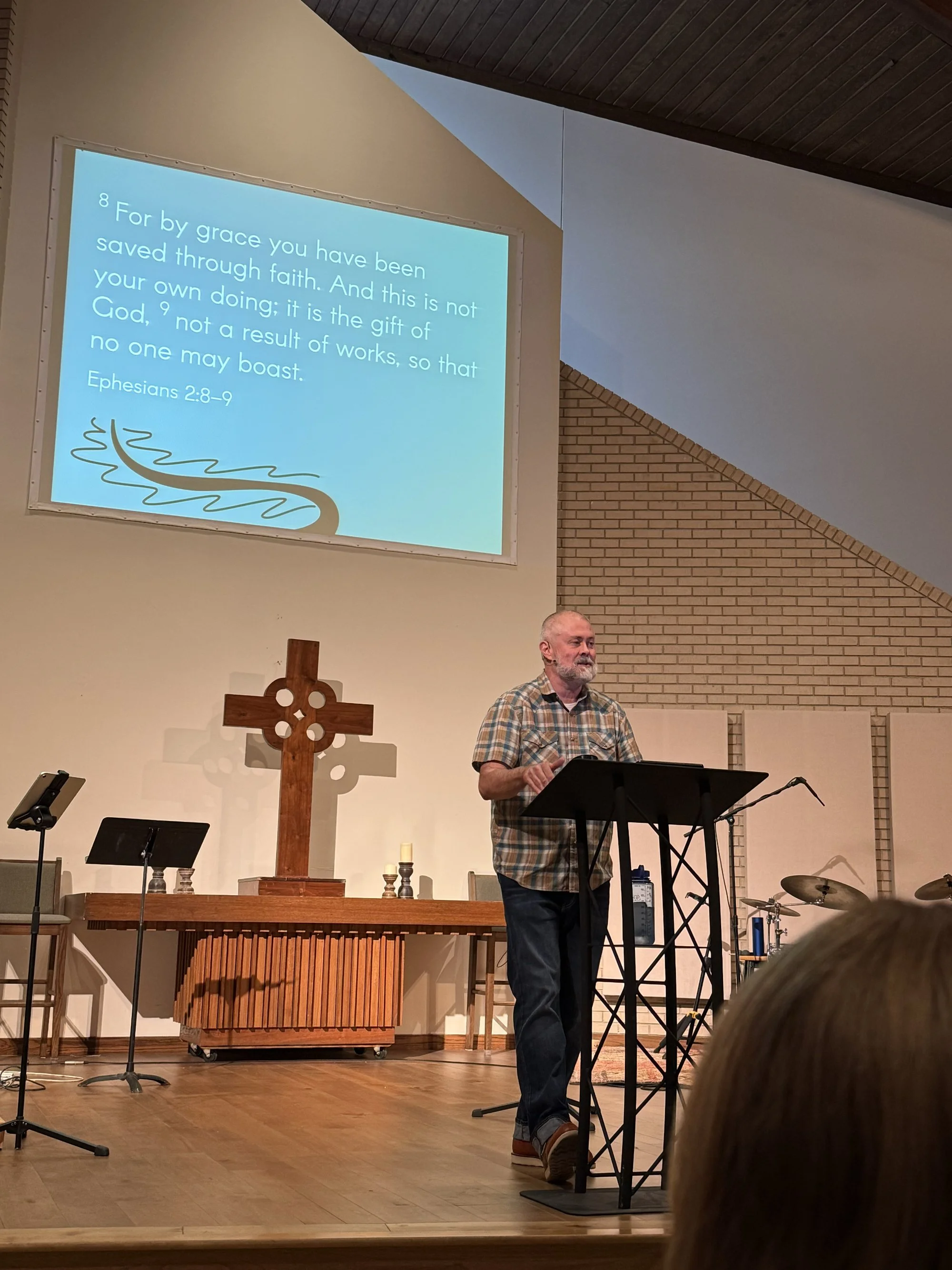
Ephesians 2:8 For by grace you have been saved through faith. And this is not your own doing; it is the gift of God, 9 not a result of works, so that no one may boast.
You look at that passage and ask, what’s exactly the gift? Grace? Faith? Which could it be? Grammatically, it’s all the rest of verse 8 - “for by grace you have been saved through faith. And this is not your own doing.” All of that in that passage is a gift. In that chapter, we’re walking around dead in our sin. Following after the world. Dominated by Satan. But God makes us alive in Christ.
Noah here isn’t anything special at all. He’s limping around - in a world of corruption - and he stumbles upon grace. He ends up on the ground. Sprawled out before the Lord. And then everything changes.
Grace finds Noah. And what does that mean again? What’s karis after all? I love Graeme Goldsworthy’s definition: “Grace is an attitude of God for the good of those who do not deserve the good.”
Noah Trusts God
The favor of God - that shines upon Noah - leads to faith. Noah trusts God. The Lord tells the guy what He’s about to do. And his servant believes Him. He trusts Him at His word. Even when all Noah can see sure makes him question. Dry fields all around. With no ocean for miles. And with all those around him likely calling him crazy. He walks by faith. That’s what these words of Hebrews 11 tells us. Right?
Hebrews 11:7 By faith Noah, being warned by God concerning events as yet unseen, in reverent fear constructed an ark for the saving of his household. By this he condemned the world and became an heir of the righteousness that comes by faith.
Noah believes. But that faith leads to works. It leads to action. He builds that ark. The Lord throws down blueprints to build this massive boat. It would have been 450 feet long, 75 feet wide, and 45 feet tall. God tells Him to load up all those animals - some to reproduce in the new world. Others for sacrifices after the flood. Some for flood until they see the dry land. God tells him stock up at the store. To get his family to pack up. And Noah obeys.
And it’s what the Lord expects of us. To see. To feel. Really experience God’s love. To respond to His call. And to act. You see, we’re not saved by works. But we’re saved to a faith that works. We’re saved by faith alone. But not by a faith that is alone. Let’s go back to Ephesians 2 for a minute.
Ephesians 2:8 For by grace you have been saved through faith. And this is not your own doing; it is the gift of God, 9 not a result of works, so that no one may boast. 10 For we are his workmanship, created in Christ Jesus for good works, which God prepared beforehand, that we should walk in them.
This is where genuine faith leads. To what Paul calls in Romans the “obedience of faith.” Noah falls down on grace. And gets up and trusts His God. And then He does what the Lord tells him to do. Three times - in verse 22 of chapter 6 and verses 5 and 16 of chapter 7 - it says that Noah does “all that the LORD had commanded him.”
Now here’s another lie that we can so easily believe. That works are optional. That we can assent to a list of facts. We can say that we have faith. But it doesn’t change the way we live. It doesn’t lead to obedience.
Look around in America today. All these people that claim to follow Christ. But they act so mean on social media. Excusing and cheering on all kinds of evil. We have Bible verses listed on our profile. But we ignore what God says about sex and marriage. No. Genuine faith leads to obedience. Not perfect obedience. We’ll still stumble and sin. But when we do, we get up and try things again.
Christianity isn’t about walking an aisle or checking a box. It’s dying to the way things used to be. And rising to walk in newness of life. More on that next week. But it’s what the favor of God does in our lives. It transforms our character. It reshapes our conduct. The Holy Spirit works His righteousness in us, if we’re His. We trip over grace and fall on our faces. We then get struggle to stand up and ask the Lord what to do. Noah trusts God. And that shows. And that’s what true conversion does in you and in me.
Back to those faulty images of God. The Lord isn’t that grandpa that doesn’t care what we do. He’s not the angry stepdad that we have to keep happy. No, He’s a good Father. He’s adopted us as His own. He’s brought us into His home. We’ve experienced His love. And for that reason, we desperately want to please Him. Yeah, He knows we’ll mess up. And He’ll forgive us when we do. And that makes us want to obey Him even more. That’s what grace does. It fills us with trust. And makes us want to love our Lord back. Again: we’re accepted. Now we want to obey.
One of my favorite lyrics comes from singer/songwriter Sarah Masen in her song “All Fall Down.” She writes, “And the fool stands only to fall, but the wise trip on grace.” Let’s not live however we want. And spread corruption. Justice is coming. And let’s not puff out our chests. Point to how great we are. Let’s trip on grace, Karis. And fall in His arms.
Now when you think about justice and works, a word might pop into your mind. Karma. Maybe? “That’s some bad karma there, bro.” Not uncommon to hear today. This idea that the choices we make now will catch up with us down the road. And the Bible does teach, of course, that you reap what you sow. And that our choices do matter. But who’s keeping score? Who’s tallying up the math?
Well, the Bible says our Lord is. That He sees. And He acts. He won’t tolerate sin. He’s just. He’ll judge. Suffering isn’t some kind of illusion. It’s something very real. That He’ll return and remove. Justice will one day roll down. But it’s also coming after us.
And that’s where Christianity offers something radically different. U2’s Bono in an interview sometime back, said this:
“I'd be in big trouble if Karma was going to finally be my judge. It doesn't excuse my mistakes, but I'm holding out for Grace. I'm holding out that Jesus took my sins onto the Cross, because I know who I am, and I hope I don't have to depend on my own religiosity.” (Bono, U2)
Jesus Jumps Overboard
Karis, Noah here is a sinner. He’ll soon take a tumble. But he reaches beyond himself to someone so much more amazing. And if we grasp this, it will deepen our love and trust even more. There’s only one who is truly righteous and blameless. Who walked with His Father perfectly on earth. Trusting Him fully. Obeying Him perfectly. And sits now reigning at His right hand. It’s Jesus.
Back when I was a kid, the Chiefs really struggled as a squad. But they drafted this running back named Joe Delaney. Who after his first season won rookie of the year. Finally, there was something to get excited about. In the second season, there was a players’ strike, and he battled an injury with his eye. But he was healthy and ready to go in season number three. But in the summer before, back in his home state of Louisiana, he saw three children struggling to swim in a pond. And he threw himself in, to try to rescue those kids, and he drowned.
Karis, as we look at this account of this flood, Jesus is the one who threw Himself in. He dove into God’s wrath. He drank that cup. So you and I wouldn’t have to ourselves. He has perfect goodness in Him alone. He let holy justice rush over Him. All for us. That’s the good news, Karis. He jumped into the flood. Took the retribution we deserved.
But He’s also the one who will triumph over His enemies. He’s the one who will restore this corrupted world. And He’ll reign over a new heavens and earth with us forever and ever, if we’re His.
We will be made fully righteous and blameless. We’ll walk in the presence of our God forever. This points also ahead to a redeemed people. You and me, if we’re believers. We’ll receive His restoration. And solely by grace.
Every week, we celebrate around the table, the Lord’s Supper. And we remember. We celebrate. How the righteous one took the place of sinners. Suffered the punishment we deserved. Alienated so that we might be accepted. We proclaim what He’s done on the cross. And that He’ll one day return and make things new.
Application
I want to end with some more words of application. How we can respond to what we’ve heard here today? First, flee His judgment, and warn others, as well. This flood again points to the fire to come. 2 Peter 2 calls Noah a “herald of righteousness.”
It sounds like he tried to warn the people of His day. Jesus said in Matthew 24, back then, people kept living as normal, “until the day when Noah entered the ark, and they were unaware until the flood came and swept them all away.” They weren’t prepared. They ignored the prophet. But what about us? Will we be ready? And will we tell others? My mind goes to the words of comedian and atheist Penn Jillette, who says to Christians,
“I don’t respect people who don’t proselytize. I don’t respect that at all. If you believe that there’s a heaven and hell and people could be going to hell or not getting eternal life or whatever, and you think that it’s not really worth telling them this because it would make it socially awkward . . . how much do you have to hate somebody to believe that everlasting life is possible and not tell them that?” (Penn Jillette)
Back on our first trip to Japan back in 2012, I stood on an empty beach. And FaceTimed my family at a very tragic site. Where a village named Ishinomaki used to stand. In March of the year before, a massive 9.1 earthquake struck off the coast of the island. And it caused 133 foot waves that wiped out many towns - including that very one. It claimed 20,000 lives. And caused a massive nuclear disaster.
But did you know alarm systems were in place, that everyone ignored? They’d grown to block out the noise. Until it was too late. And the hills along the coasts were marked by stone markers, some of which that were 600 years old - that warned of the dangers of building below that point. Justice will roll down. We learn that from Scripture. Will we be ready? And will we warn others?
Second, work for justice, and resist vengeance, also. Again, the Lord is bringing judgment. But He’s also giving the world a new start. And pointing ahead to the shalom that’s to come. If this world will be renewed, why wouldn’t we work for that kingdom of God right here, right now? Fighting sex trafficking. Alleviating poverty.
Here’s an interesting thought that hit me studying this passage. The corruption of humans corrupted all the rest of God’s creation. It led to the death of animals and plants. An ecological catastrophe. But God gave it a good refresh back then. And one day, it’ll be the ultimate home makeover. What if we were the best environmentalists of them all? After all, we actually have the grounding to care about the creation. It was made by our God. And He gave it to us to steward. Don’t buy the lie that you can’t believe in eternal punishment and also be an environmentalist! Our faith, Christian, doesn’t fit into those boxes.
But let’s also resist vengeance. We might think God’s judgment gives us the right to judge, too. But don’t buy that either. If we believe the Lord is judge, and will hold everyone accountable. That vengeance is His. Not ours, as Paul says. It frees us to love. It frees us to forgive. And that takes us back to that earlier quote from Volf. About it takes a spoiled suburban kid to not long for justice. He also writes,
“Without entrusting oneself to the God who judges justly, it will hardly be possible to follow the crucified Messiah and refuse to retaliate when abused. The certainty of God’s just judgment at the end of history is the presupposition for the renunciation of violence in the middle of it.” (Miroslav Volf)
If we believe God is just, we’ll labor to make things right here. But we won’t try to get revenge, as that’s not our job. We can lay down our arms. We can love and forgive.
Third, check your heart, and see if you bear fruit. In 2 Corinthians 13:5, Paul writes this:
2Corinthians 13:5 Examine yourselves, to see whether you are in the faith. Test yourselves. Or do you not realize this about yourselves, that Jesus Christ is in you?—unless indeed you fail to meet the test!
Think of your lives as a tree — an image used by Jesus. Look at your root. Where’s your trust? Is it in the Lord - and what He has done? Or maybe in something else - an idol, a false god? What really moves you? What do you really live for? Sex, money, or power? Your job? Your spouse? Have you tripped on grace? Have you encountered God’s love?
And check your fruit. Are you seeking to do what Jesus asks? And especially to life a live of love? Are you truly converted? Do you walk in the obedience of faith? Not perfectly. But sincerely. Faith without works is dead. Examine yourselves. Are you a Christian, my friend?
Fourth, ponder His call, and where God might lead. Here, the Lord approaches Noah, and he gives him this task. He tells him to do something crazy. To take a really big risk. Out of faith. And Noah obeys. What might the Lord be asking of you now? Where might He be leading you, Karis?
Maybe to jump into some ministry you’ve been fearing. Or to start a business that could bless a lot of people. Maybe he’s telling you to repent of some sin. To believe that He’s better. Or to really believe something you’ve read in His word. Will you do what God says? Even if it seems kinda crazy? And maybe even your friends don’t understand? How might God be convicting you? How might He be calling you? Where might He lead?
Mercy That Surprises
Back many years ago, a young woman named Rachael Denhollander stood in front of her abuser in court. She was the first woman to file charges against Larry Nassar, a doctor who sexually abused countless gymnasts like her. And she said these words, explaining that the word of God,
“…carries a final judgment where all of God’s wrath and eternal terror is poured out on men like you. Should you ever reach the point of truly facing what you have done, the guilt will be crushing. And that is what makes the gospel of Christ so sweet. Because it extends grace and hope and mercy where none should be found. And it will be there for you.” (Rachel Denhollander)
Justice is often seen as the scandal today. But it’s truly what all of us long for deep down. And what should shock us and surprise is grace. And a faith that works - that loves and forgives - is sadly seen as unusual today. But it should be the norm. It’s what God’s favor does.
Like a diamond twinkles and glimmers, placed against a black velvet background, the grace of God shines brightly in contrast to the justice that is to come and that all of us deserve. It’s like that rainbow that bursts out from a dark, cloudy sky. More on that scandalous mercy next week, as we look further at this ark. Karis, justice will roll down, but the wise trip on grace. Will you fall down with me, Karis? Let’s pray.