
Embodying Together (the Gospel of Grace) (John 20:21)
Below is my manuscript from the second sermon in our fall vision series, as we walked through our new Karis mission statement. You can listen to the audio here.
Well, I never thought I’d live in an age of self-driving cars. And I never dreamt I’d hear a president say, “The robots are not going to be taking over the world.” But here we are. Last week, a young man named Jacob Coxon, a researcher for Anthropic, abruptly resigned, claiming on X that such AI companies were “gambling with our lives.” He went on to say, in a barrage of disturbing posts, that “the people building AI earnestly believe that it could kill us all by the end of the decade.” Now, that’s disturbing to say the least. By the end of the decade? What? Now, it’s good that this has seemed to wake some people up. And the tech heads claim they’ll now work together. But it’s still pretty concerning.
Yet I heard something recently that rattled me even more. A ministry friend shared with me - about a situation in their church. A woman had decided to leave her husband. Had begun pursuing another man. In large part because of the counsel she had received from - wait for it - Chat GPT. Now I don’t mean to shame you, if you’ve ever bared your soul to your phone. But what this woman needed - and you and I need, too - is something real, not artificial. A human, a friend. A brother or sister in Christ. With true intelligence. Better, with the Spirit of God. What we need is genuine presence. To help us navigate this fallen world. As the storm rages around us.
In Karis, we do what are called expositional sermons, where we slowly walk through books of the Bible, hearing what the Lord says to us there, asking how it applies to our lives. But we’re taking a break from our look at Genesis for a short, fall vision series. Where we’re walking through our new mission statement - that reads like this:
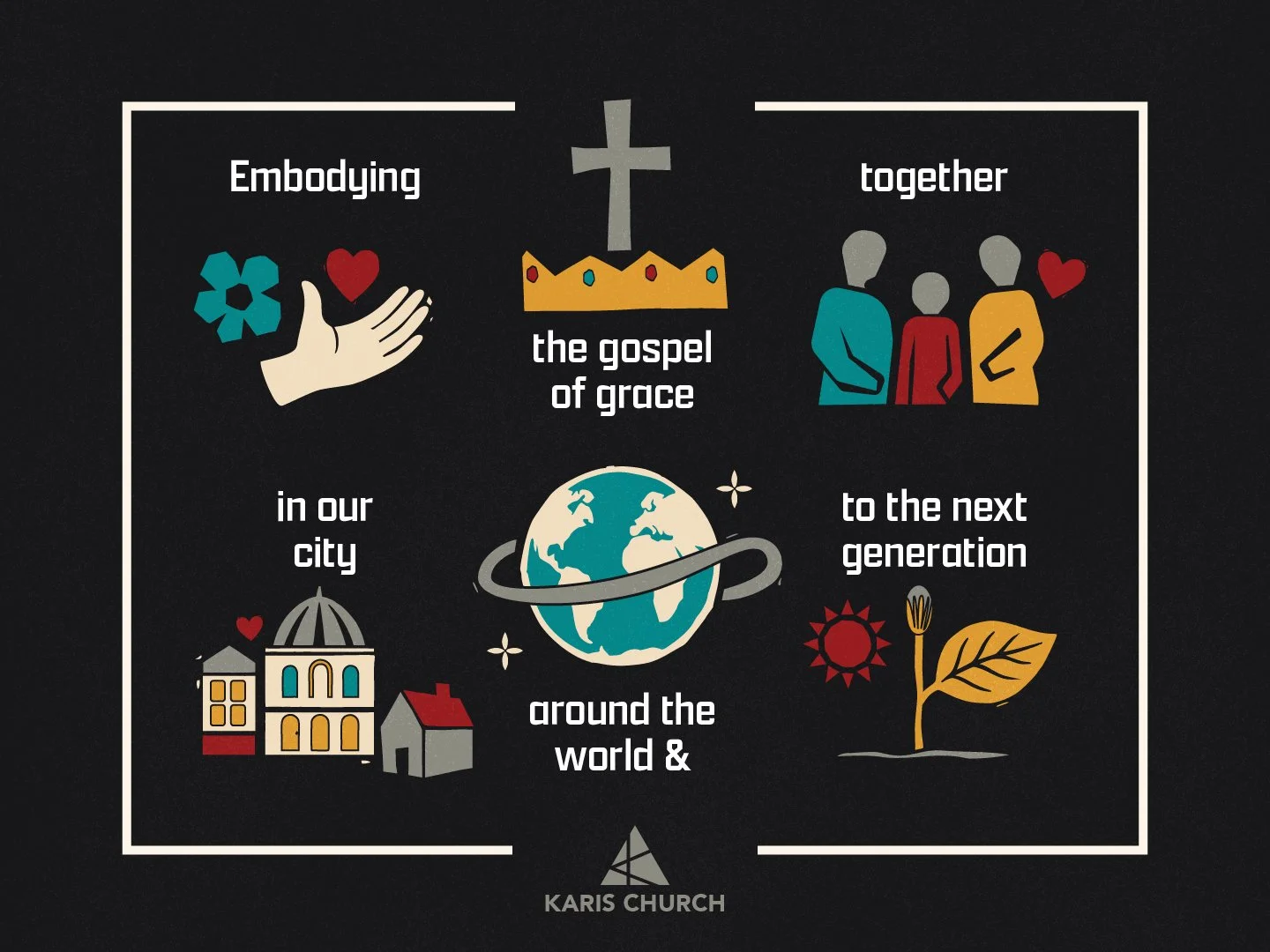
Karis Church exists to embody the Gospel of Grace together - in our city, around the world, and to the next generation.
Last week, Aaron talked about the “gospel of grace.” This week, we’ll see how we’re meant to embody it together. And we’ll focus on a section from the end of John.
Peace to You
Their Lord had just been crucified. His disciples are cowering in fear. They’re grappling with what had transpired. There’s a storm raging in their hearts. When suddenly Jesus just appears. There in that locked room. And He tells them, “peace be with you,” we see in verse 19. Jesus tells them, “You don’t have to fear anymore. You don’t have to worry. Peace has come.” And after their hearts stop racing, from that crazy Jesus jump scare, they no doubt have a feeling of deep, subjective peace.
Verse 20 says that they’re “glad.” After He shows them “His hands and His side.” And it’s there He shows them how this peace comes about. His hands nailed to the cross. His side pierced by those soldiers. He comes to bring peace. The Lord wants them to grasp the objective peace that was accomplished. There in His substitutionary death. This war - between a holy God and sinful humanity - has been ended. On that tree. By His wounds. Jesus threw Himself into that storm. There’s redemption through His blood. And now the skies are calm. The cross is good news. It brings peace.
But we also await a kingdom. Yes, “peace be with you” was a greeting in that day. But it goes deeper than we might think. That word for peace. It’s shalom. A rich Hebrew word that means wholeness. Wellbeing. Total welfare. Flourishing in every aspect of life. It’s the hope of everything messed up by the fall finally made right. His kingdom has broken in to the here and now. And it’ll one day come in full - and will last forever. Where we’ll be resurrected like Him. And this broken world will be restored. Because of what Jesus has done - and what He’ll do - we can truly have peace here and now. And hope for the future. In His presence.
That’s the gospel. It comes by His grace. And it brings us peace. And that’s something we’re meant to proclaim. But it’s also what we’re meant to embody. And that’s where we’re going today. The gospel needs some skin on it.
He Put on Skin - Incarnational Ministry
Jesus then tells the disciples - there in verse 21 - “As the Father has sent me, even so I am sending you.” Now that first clause - “as the Father has sent me” - points to this amazing truth, of the incarnation of God. Anybody love some carne asada? I sure do. Asada? That means “roasted” or “grilled.” Carne? We know what that means. This is Jesus, eternal God the Son, putting on “meat.” Not losing His divinity. But adding humanity. As it’s put way back in the first few verses of John - in chapter 1, verse 14 - the eternal “Word” of God - that’s Jesus - He “became flesh and dwelt among us.” Or the way, I like to put it: He put on skin and moved into our hood.
What an amazing truth! Jeremy did a fantastic job of walking us through Philippians chapter 2 - just a few weeks ago. How amazing that the Lord didn’t keep holding on to what was rightly His. He let it go. He emptied Himself. By adding a body. Becoming a servant. Being born as a man. In a desire to reach us. This is the gospel - embodied. In Jesus. In His incarnation. He puts skin on. For you and me. The Creator we’ve seen in Genesis. He becomes a part of that creation. As the church father, Irenaeus, once put it, “Because of His measureless love, He became what we are in order to enable us to become what He is.”
But the second clause of that verse says something also amazing. He wants us to put on skin, as well. Jesus says, “As the Father has sent me, even so I am sending you.” Yes, we’re already human. And you and I will never save anyone. But just like the Father sends Jesus into the world, He also says He’s sending those disciples. And that, of course, includes us. Our life together - our ministry as His people - is also meant to be incarnational.
We’re meant to draw near to others. To move into their hood. Not ask them to come to ours. We’re called to put on skin. To not cling to our privileges. To lay that all down. As humans and sinners, we desperately want to protect our comfort, to keep our distance. We try to make our lives - and faith - only go skin deep. But God wants us to embody the gospel of grace. We like to the keep our beliefs in the realm of the hypothetical. But the Lord wants something real. Something with meat on it. Not abstract. But concrete. The word now - like then - still needs some flesh on it.
Maybe you’ve heard someone say, when you’re talking about Christ, “I’m not just not seeing it.” Elsewhere in John, Jesus tells Philip, “If you’ve seen me, you’ve seen the Father” (John 14:9). And in a sense, for sure - not saying it’s exactly the same - the Lord wants us to also be able to say: “If you’ve seen me, you’ve gotten a glimpse of Jesus.” We’re meant to embody the gospel. To make what’s invisible visible. To have an incarnational life and ministry together. To put on skin.
We’re His Body - Relational Ministry
But there’s another important detail we can’t overlook. When the Lord says, “even so I’m sending you,” that word for “you” is plural. In SEC English, it should be translated as “y’all.” Yes, Jesus is talking to those 12 - really 11 at the time - but by extension, also all of us. There’s another way we embody Jesus. How we put skin on the gospel. It’s together.
In the book of 1 Corinthians Paul talks about spiritual gifts. The diversity God has given. How they all come from the Lord. How every one is important. That they’re meant to benefit us all. To build one another up. And the apostle says, in verse 27, “Now you are the body of Christ and individually members of it.”
Do you catch what this means? Together, we embody the gospel. We put skin on the message. Make the word become flesh. As a community. Yes, the Father sent the Son, out of love, for our good. But from eternity past, it’s been Father, Son, and Holy Spirit in perfect fellowship. And that God chose to let that spill over. A waterfall of delight. To create a community of love. Gospel family. And we’re caught up in that, if we’re followers of Christ. Our life and ministry together is also meant to be relational.
We’re meant to draw near to others. To share all we have. To carry each others’ burdens. To tie our joy up in others’. As Paul talks about, in those earlier verses of Philippians 2, to pursue the same mind and love. Unified in Christ. Not thinking just about our goals and desires, but putting others and their interests even above our own. As humans and sinners, we deeply want to guard our freedom. To avoid any kind of pain. To save our own skin. But God wants us to open up our lives, to take risks for one another. To embody the gospel of grace - together.
Maybe you’ve also heard someone say, when you’re trying to share Jesus, “I’m just not feeling it.” But one of the main ways people get moved by the gospel of Christ - really experience it - is by seeing, really feeling, the love of His body. You may know these words of the Lord, from John 13:
John 13:34 A new commandment I give to you, that you love one another: just as I have loved you, you also are to love one another.
John 13:35 By this all people will know that you are my disciples, if you have love for one another.”
We’re meant to make the intangible tangible, friends. Through our fellowship. Through our hugs. We’re meant to embody the gospel. But never alone. Always together. To have a relational life and ministry. To put on skin. As the body of Christ.
He Came to Die - Sacrificial Ministry
But let’s go back a second to Christ pointing to His wounds. His pierced hands and side. Why did Jesus put on skin, and move into our hood? To bring us peace. But first, He had to die. That baby in the cradle - was born for the cross.
The Lord had said earlier, in John chapter 10, verses 14-15. That He’s the good shepherd. “I lay down my life for the sheep.” That’s why He came. He was born to die. As Philippians 2:8 puts it, "Christ humbled himself, by becoming obedient to the point of death.” Now you and I can’t atone for one another. But our Father calls us down that same road. To take up the cross and follow Him. As humans and fallen sinners, we avoid having any real skin in the game. We want to be the ones served. To think about only ourselves. But we’re called to suffer, to die. To bleed for one another. To not just follow the pattern of the incarnation. But that of the crucifixion.
We try to make our relationships together transactional. I give you something. You give it back. Or else, I’m out. But God wants us to walk in the light of His grace. To live lives of love. To embody the gospel. And in the most powerful way. As we give our lives for others. To have a sacrificial life and ministry. To not just put on skin. But let it bleed. To be a presence. To bring others peace. To endure pain to bring it about. Like our Lord.
Our Song and Identity
Karis, we have this amazing story. Of the peace Jesus brings. Through His presence on earth. He wanted a relationship with us. And gave His life to bring it about. We get to sing this song. And call others to join in. That’s our story. And it’s beautiful.
But this also creates in us an identity. Sent into this world by Him, we also follow in this pattern He gave. We put some skin on that story for others. As His children, as His servants, we live an incarnational, relational, and sacrificial life. Our story that we get to sing. Leads to an identity. And that, of course, transforms our activity.
And that’s where I want to turn more specifically now. How can we, as Karis Church, live out this? How can we embody the gospel - together? What should characterize our activity, friends? Let’s think of it in terms of our community, but also our mission.
Our Community
First, let’s take community. There is an epidemic of loneliness in society today. With social media, we’re superficially connected to so many people. But we’re deeply in community with very few. Fewer people go out. We sit home and scroll. And, as we do, we’re shrinking our souls. Because were made for so much more.
For each of these last two categories, I want to give you three verbs. Really three challenges - how we can seek to live this out. And here, talking community: identity with Christ’s body, love God’s people, and persevere through difficulty.
Identify with Christ’s Body. Do you know what Jesus said to Paul, when He appeared to him on that road? In Acts 9:4, “Saul, Saul, why are you persecuting me?” Jesus identifies with His church that closely. Will you and I do the same?
I want to encourage you. Pick a local church. Commit yourself to there. Be present. And dig in. To specific people, real flesh and blood, whose names you know. To church leaders you know and trust. Be accountable to others. Use your spiritual gifts. Yes, actually join a church. A people you can embody the gospel with.
No, online church won’t cut it. The church is a body. It’s a people. Not an episode in your queue. Or a podcast in your feed. Your pastor isn’t a hologram. Or an AI avatar. And he shouldn’t be writing his sermons with chat GPT, either. He should be speaking to real people. Whose needs he knows. The church shouldn’t be digitized. It’s not meant to be virtualized. It’s embodied. Listen to how Dane Ortlund puts it:
“Staying home to ‘watch church’ is like staying home from a friend's wedding to watch the ceremony virtually. And keeping your wedding gift with you. Your presence and solidarity and love and hugs and eye contact and singing are needed. It's not just about passively receiving something. It's about being an embodied part of the celebration. The whole event is diminished by your absence. And you have a gift to give.” (Dane Ortlund)
Church isn’t an event. Or experience. Where you get religious goods and services. Church also shouldn’t be commodified. It’s a living, breathing people. And you and I aren’t meant to be a customer but a part of gospel community.
We love to fight for our autonomy today. To keep our options open. We fear making a choice. Maybe missing out. What if that church down there has better sermons? It probably does. But that’s missing the point.
Yes, you can find a solid podcast. You can stream all the worship hits. But if that’s what you choose, you’ll truly be missing out. It’s in limiting ourselves, in identifying with, and committing ourselves to, His body - in being present among His people - that we experience the life that we were meant for. Karis, I’m calling you to recommit to that. If you’re new to Jesus or church, take a risk and try.
Love the people of God. It’s easy to say we love everybody. It’s another thing to love specific people with their quirks and foibles and troubles and sins. You know all those “one anothers” that we see throughout Scripture? Those are to get played out here, among His church. Now that goes against the grain of what we’re taught in our culture. To actualize and express ourselves. But God wants us to walk in the steps of our Lord. To think about others. To come near to them. To love. And to love until it hurts.
And to allow people to love us. To rejoice when we’re up. To weep with us when we’re down. To encourage us in our faith. And love us enough to help us change. To call us out when we sin. To come after us when we stray. We all want to be known and loved. But to truly be known, we have to get close. We have to take off the masks. We have to tear down the walls. And let people see who we are. As Ray Ortlund once wrote, “You can be impressive. Or you can be known, but you can’t be both.” Back in that garden, humans are there, joyful in God’s presence, “naked and unashamed.” To really experience love, we have to pursue vulnerability. Through the redemption of Christ. To show some skin, if you will. To experience His peace, we have to offer our presence. And be authentic with one another.
Elsewhere Ray talks about how we’re good at gospel doctrine. Knowing what we believe. Arguing about it with others. What we really need is a gospel culture. Where we extend His love to others. Where we grant each other, as he puts it, “Gospel plus safety plus time.”
As we learn to love specific, flesh and blood people, then we get to see the power of the gospel. As we embody it together. Friend, will you open up to that? Karis, will you re-up for that kind of love?
Persevere through Difficulty. But that’s scary, right? Because we don’t want to get hurt. But let me be honest with you. You will. I’ll disappoint you. I can guarantee you that. Others will, also. And you’ll let them down, too. That’s how family life works. And it’s how we truly grow. What happens so much in churches today - and really in relationships in general - is that things get hard, and people freak out and leave. But hear me: a healthy church isn’t one where there isn’t any conflict. It’s one that handles it in a healthy way. Where people sit down and talk and pray. Where they seek to reconcile and forgive. And then you get up, share a hug, and find your relationship has grown deeper. And it’s going through those challenges that really brings change.
I love the way Joseph Hellerman puts it:
“Spiritual formation occurs primarily in the context of community. Persons who remain connected with their brothers and sisters in the local church almost invariably grow in self-understanding. And they mature in their ability to relate in healthy ways to God and to fellow human beings. This is especially the case for those courageous Christians who stick it out through the messy process of interpersonal conflict. Long-term relationships are the crucible of genuine progress in the Christian life. People who stay grow.
People who leave do not grow. We all know persons consumed with spiritual wanderlust. We never get to know them well because they cannot seem to stay put. They move from church to church, avoiding conflict or ever searching for a congregation that will better satisfy their felt needs. Like trees repeatedly transplanted from soil to soil, these spiritual nomads fail to put down roots, and they seldom experience lasting, fruitful growth in their Christian lives.” (Joseph Hellerman)
I really love college football and following our Tigers. But it’s no fun to constantly learn a new roster. Now with the transfer portal - and NIL - if someone gets frustrated, or thinks the grass might be a bit greener, they bolt and leave. And therefore, the connections are looser, the relationships are shallower.
We in the church can live the same way. But we were made for so much more. Yes, the church is a place where you will get hurt. But it’s also a place where you’ll get healed. Pastor Jeremy Treat recently posted this:
“Commit to a local church, instead of me-centered spirituality.
Follow your pastors, instead of adoring celebrity pastors.
Invest in embodied relationships, instead of settling for digital connection.
Embrace the mess, instead of bailing when it gets hard.” (Jeremy Treat)
Friend, will you give it a go? Karis, let’s keep at it - together!
Our Mission
Let’s think now about our mission together. Show the world glory. When we commit to one another. When we sacrificially love. And we stick it out over the long haul, we embody the gospel before the world. And our love together is the strongest apologetic - or defense - of the gospel. Listen to Mark Dever:
“The doctrine of the church is important because it is tied to the good news itself. The church is to be the appearance of the gospel. It is what the gospel looks like when played out in the lives of people. Take away the church and you take away the visible manifestation of the gospel in the world. Christians in churches, then, are called to practice ‘display evangelism,’ and the world will witness the reign of God begun in a community of people made in his image and reborn by his Spirit. Christians, not just as individuals but as God’s people bound together in churches, are the clearest picture that the world sees of the invisible God and what his will is for them.” (Mark Dever)
This is John 13:34-35 again. The world will know we are His - by our love!
We are so polarized today. And people desperately want community. They’re settling for cheap imitations of that online. We get to show people what the gospel looks like. As we love, we show them glory. As we’re present together. Showing them His peace. Please, join us in that. Karis, let’s keep rolling with that.
Invest right where you are. It’s well-known that social media also makes us anxious. I’m sure there a lot of reasons. But a big one is that we’re exposed to all the world’s problems, and there is not much that we can do. And that can be so overwhelming. But we can roll up our sleeves and do something right here. Offer presence. Bring peace.
Let’s bless this place. And the people that live here. Yes, we care what’s going on around the world. We appropriately love our country. But, as many have said, “We should think globally, but act locally.” You might have heard of author Wendell Berry. He died this month. His legacy might be - more than anything - encouraging people to dig in, where they are. You may be here and you might be passing through. So many of us here, have made Columbia our home. Let’s put down roots. As long as God has us here. Go to a PTA meeting. Clean up litter. Rake your elderly neighbor’s leaves. Volunteer for a non-profit. And be a blessing. There we’ll find ourselves blessed. And embody the gospel together. You wanna be present with us here? Karis, let’s keep making this home.
Spread His love broadly. As we love each other in community, and we invest ourselves in our city, we carry our love there, as well. We humble ourselves. We give of ourselves. Moving toward the hurting. Toward people unlike us. Having conversations. Meeting needs. We embody the gospel. We show its beauty.
In Wendell Berry’s novel Jayber Crow, the main character Jayber is waiting his turn in a barber shop. He overhears Troy, another customer there, in an earlier era, railing against the Communists - proclaiming how they all need to be shot. Jayber turns to Troy and says, “Love your enemies, bless them that curse you, do good to them who hate you.” Troy then replies, “Where did you get that crap?” To which Jayber responds, “Jesus Christ.” All Troy then can do is sheepishly respond, “Oh.”
Sadly, this is the way Christians are too much seen in America today. As Russ Moore has put it, it’s gone beyond people - when it comes to Jesus - saying they just can’t believe. The problem is that they doubt that we even believe our own teachings. They can see the beauty of how Jesus lived. But as they look at the church what they see is just ugly.
What if we loved our story? And lived out this identity? And were incarnational and relational and sacrificial - like Jesus? And shared this love? If we had a gospel culture in here - that spilled out into the culture out there - into our turbulent world? What if we let go of convincing people that Christianity was true. But we showed them through our lives that it was beautiful and good? Through our presence - embodying the gospel together - bringing peace? If you’re new, just checking us out, will you join us and love? Karis, can we pursue this - here over the next 20 years?
Receive the Spirit
After the Lord gives them and us this commission, He says these puzzling words in verse 23. “If you forgive the sins of any, they are forgiven them; if you withhold forgiveness from any, it is withheld.”
No, we don’t have the power to forgive anyone at all. But, as we proclaim the gospel, and we watch them respond. Jesus is saying that reflects what the Father is doing in heaven. Again, He identifies with us just that much. And the gospel isn’t just lived. It’s spoken. It’s made flesh - but it’s still the word. Peace is coming! Peace is here! This is our message that we embody. But also proclaim.
But just before that, it says the Lord breathes in verse 22. Upon His disciples there. And He says, “Receive the Holy Spirit.” Yeah, the Spirit is poured out later at Pentecost. But here Jesus gives them a promise. Maybe more like a preview. In that little burst of breath. Of the winds that were to come. There in His presence. Being told to be a presence. He promises them His presence. As Robert Smith Jr. puts it: “God as Father is God without human skin. God as Son is God who comes with skin. God as Spirit is God who gets inside of our skin.” That is His promise, Karis, as we embody His gospel together. As we carry and display His word, He gives us His Spirit. We’re not alone. We have His power.
The Song in the Storm
Karis, the good news - the gospel of grace - is that Jesus put on skin. And He dove into the storm. The wrath of a holy God set against our sin. The Father sent His beloved son, that His body - his hands and side - might be pierced. That His flesh would bleed. To still this storm in our hearts. To quell that storm in our world.
Picture a small child - afraid to go to sleep. Her father comes in - “It’s just thunder, sweetie. Jesus is with you!” And the little girl replies, “Would you please stay? I want someone with skin on.”
Karis, Jesus is here. But we get to embody the gospel together. To put some skin on it. For each other. For our world. Bring presence. Offer peace. As we live this life together - incarnation, relational, sacrificial.
We have this song to sing. Amidst the storms all around. Of God’s presence coming to earth to bring us His peace. Let’s be a presence ourselves - instruments of His peace - together.
Next, we’ll turn to where this mission gets lived out. We embody this gospel in our city, around the world, and to the next generation. Join us next week, as we talk about our calling here in Columbia. Let’s pray.